


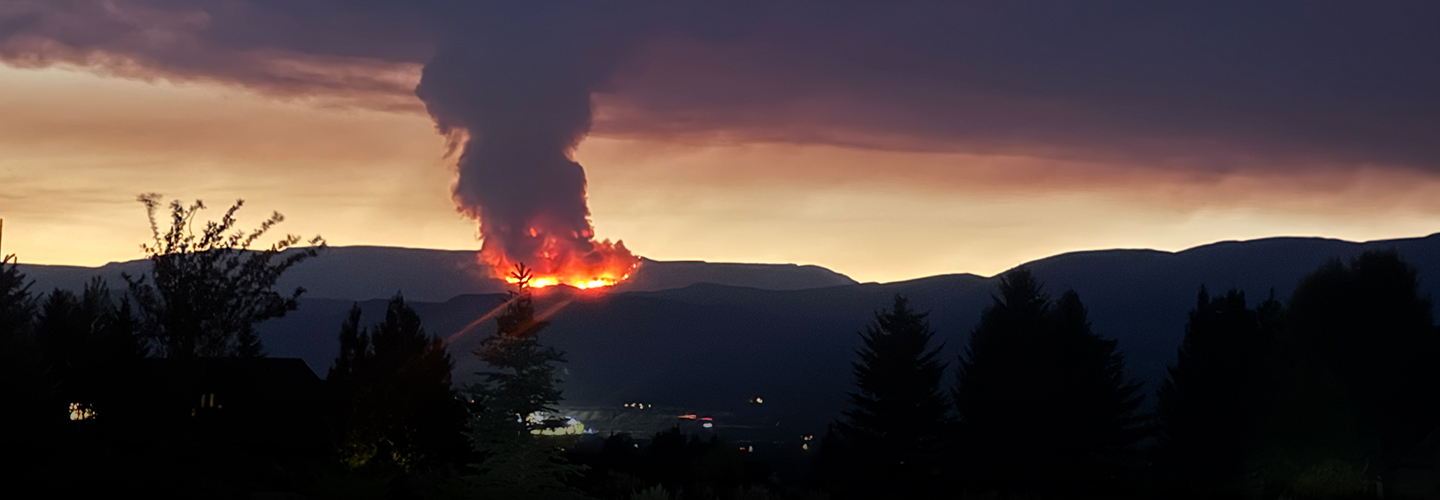
In Gypsum, Colorado, wilderness meets civilization. Mountain peaks reach up to 12,000 feet around this part of northwest Colorado, where you can find the Colorado River, I-70, and the Vail ski resort. With that wilderness comes immense beauty, and areas with little to no telecommunications infrastructure. For the Gypsum Fire Protection District, this presents serious logistical challenges for the small agency with hundreds of miles to protect.
The district relies on FirstNet phones, push-to-talk devices, tablets, and mobile data terminals to stay connected to critical information.
“I rely on FirstNet every day for everything. We’re 100 percent in for our data, our push-to-talk, our interoperability for our radio channels — everything,” said Chief Justin Kirkland of the Gypsum Fire Protection District.
Enhancing day-to-day operations and connectivity for staff
The network’s reliability enables the team to communicate regardless of location — a feature that’s vital to Gypsum Fire Protection District.
“The majority of our staff do not live here,” Kirkland explained. Some staff members travel up to two hours to clock in, but their radio systems are regionally limited. Historically, when staff members would leave the district, they could not use Gypsum’s radio systems without borrowing bandwidth from other districts.
To address that challenge, the team set up a Radio over IP (RoIP) connective solution in the station. Using a RoIP device and FirstNet’s enhanced push-to-talk app, staff can now communicate regardless of their location, enabling team members to monitor situations remotely.
The agency also relies on FirstNet’s network for Colorado Team Awareness Kit, a state-provided location services application that allows the team to track each other, share intelligence, and collaborate over maps. In hazmat situations, an individual with a ruggedized FirstNet-enabled device can enter a scene while another watches a live video feed and provides guidance in real time.
“We rely on FirstNet because of the priority and preemption. I’m not worried about whether I have enough bandwidth or not,” said Kirkland.
Deploying in an emergency: The Derby Fire
In 2025 in the town of Dotsero near Gypsum, a lightning strike started a fire on federal land. The fire grew within 24 hours to threaten more than 300 nearby homes in Sweetwater.
This fire posed a twofold problem for the district: first, Sweetwater had little to no cell infrastructure. There was a remote fire station nearby, but it had no phone lines. Second, unlike most fires, the Derby Fire — as it was eventually named — primarily grew at night, fueled by downslope evening winds that pushed the flames into vegetation. Between the nighttime expansion of the fire and lack of cell service, maintaining situational awareness was a major challenge.
The district’s priority was to get communication lines up. Linking low earth orbit (LEO) satellites through Starlink to a FirstNet Cell Booster Pro, a device that acts as a miniature cell tower, Kirkland set up cell service from the remote fire station. The connectivity allowed first responders on the scene to receive and transmit data.
The newfound connectivity proved important for other responding agencies as well. Mutual aid partners were able to download maps that connected to live location data, send status updates to teammates, order supplies and medication, and navigate rugged terrain using FirstNet.
First responders were able to leverage Wi-Fi over LEO satellites. This enabled Kirkland to move the Cell Booster Pro into his car, allowing him to bring cell service wherever it was needed.
“Since the Derby Fire and the success of this connection, I now keep a kit with Starlink and the Cell Booster Pro in my vehicle so I can quickly deploy FirstNet coverage anywhere needed,” said Kirkland.