


This blog is a repost from Urgent Communications, originally published on July 29, 2026.
This blog post is part of the “Tech Talk” series focused on the First Responder Network Authority’s (FirstNet Authority) standards development activities to support public safety. This post recaps discussions linked to public safety and other related topics from the 3GPP plenary meetings that were conducted in June 2026. The FirstNet Authority represented public safety interests at the plenary meetings.
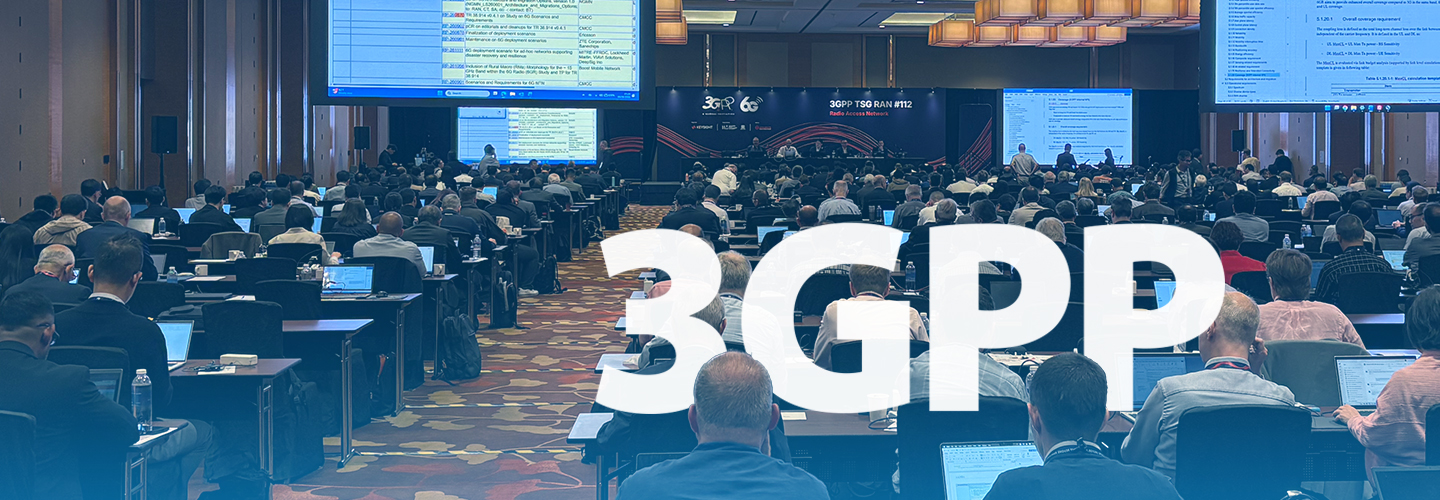
Members of the FirstNet Authority Standards Team participated in the June 2026 3rd Generation Partnership Project (3GPP) Plenary in Singapore. The global telecommunications industry gathers at 3GPP meetings to develop the technical specifications that underpin Long-Term Evolution (LTE), 5G, and future wireless technologies, including 6G.
3GPP Technical Specification Groups (TSGs) plenaries meet quarterly, with working groups meeting between plenaries to develop detailed technical specifications. This work ensures interoperability among networks, vendors, device manufacturers, and application developers.
For the FirstNet Authority, participation is more than an opportunity — it is a statutory responsibility. Congress directed the FirstNet Authority to engage with 3GPP and other telecommunications standards bodies to ensure public safety requirements are represented as global broadband standards and networks evolve.
Why 3GPP matters
3GPP standards define the technical foundation for mobile communications worldwide, shaping network architecture, security, interoperability, mission-critical services, spectrum use, and emerging technologies.
Because FirstNet is built on globally standardized technologies, decisions made in 3GPP directly influence capabilities such as mission-critical voice, video, and data; high-power user equipment (HPUE); resiliency; quality of service; priority and preemption; security; and interoperability.
As industry attention shifts toward 6G, early engagement is critical. While 5G continues to evolve, 3GPP is now establishing the technical foundation for next-generation wireless systems. Active participation allows the FirstNet Authority to advocate for public-safety requirements before standards are finalized, helping ensure future technologies support first-responder operations.
A unique voice in standards development
Unlike most 3GPP participants—who represent commercial operators, vendors, manufacturers, or the general public through government agencies—the FirstNet Authority specifically represents the operational needs of public-safety agencies across the United States. This perspective ensures emergency response, disaster recovery, incident management, and mission-critical communications remain part of international standards discussions.
As broadband becomes increasingly central to public-safety operations, sustained engagement helps ensure future technologies remain reliable, secure, resilient, and interoperable. No other U.S. government agency or vendor has this level of public-safety expertise and influence. Ultimately, this work helps public safety do their jobs better, more safely, and with better outcomes for the American public, at large.
Major outcomes from the June Plenary
The primary focus of the June meetings was Release 20 (R20), which continues advancing 5G-Advanced (5G-A) while laying the groundwork for 6G.
The March 2026 TSG Service and System Aspects (SA) plenary meeting—with the approval of the initial 6G requirements study item and the approval of the initial 6G requirements work item—marked the beginning of the 6G normative specification development. With many other working groups beginning their study items on 6G, the June plenary meetings truly showed the beginning of the 6G era.
The three TSGs also finalized the Release21 (R21) schedule, which combines continued 5G-A work with the first normative 6G specifications:
- Stage 1 requirements Freeze: March 2027
- 5G-A/6G Package Approval: March 2027
- Stage 2 Architecture Checkpoint (80%): March 2028
- Stage 2 Architecture Freeze: June 2028
- Stage 3 Protocol Freeze: December 2028
- ASN.1/OpenAPI Freeze: March 2029
Engagement across all technical areas
The FirstNet Authority participated in all three TSGs:
- Radio Access Network (RAN)
- Service and System Aspects (SA)
- Core Network and Terminals (CT)
Participation in all three groups provides visibility into the complete standards lifecycle, from service requirements and system architecture to radio technologies, protocols, and device interoperability. Participating in the three groups allows the team to identify emerging technologies and assess their impact on public safety.
SA
The SA Plenary drew more than 375 attendees and focused on R20 5G-Advanced progress, R20 6G studies, and the initial progress of the first 6G work item.
Public-safety priorities advancing in R20 include proximity-services enhancements supporting user-equipment-to-user-equipment (UE-to-UE) multi-hop communications, integration of satellite components into the 5G architecture, Artificial Intelligence/Machine Learning (AI/ML) enhancements, integrated sensing and communications (ISAC), Ambient Internet of Things (IoT), and extended reality and media services (XRM).
Overall, R20 work remains on schedule, with few issues raised at the plenary.
SA1 is a working group that develops service and system requirements. During the first quarter of 2026, SA1 completed the R20 6G Study Item, which includes more than 200 use cases, and it developed the first R21 6G Work Item Description (WID) to begin normative requirements development.
During the second quarter of 2026, the group established the document framework, incorporated legacy operational and system requirements, and began developing requirements for artificial intelligence, ubiquitous connectivity, vertical industries, public safety, and robotics. The work item is approximately 20% complete and remains on track for completion in March 2027. Discreet listening allows authorized personnel to remotely monitor ongoing incidents without requiring user interaction, supporting situations such as hostage incidents or other emergencies where responders cannot safely communicate.
SA2 is responsible for the 5G System and Evolved Packet System architecture. The group continued advancing R20 5G-A and R20 6G studies.
As reported in the FirstNet Authority’s December 2025 Tech Talk, SA2 completed the technical specifications for proximity services supporting UE-to-UE multi-hop communications. Additional work continues in SA3, CT1, and RAN to support these capabilities.
SA2 also completed the 5G-A architecture technical reports for several high-priority public-safety features, including satellite integration, ISAC, AI/ML support in the core network, and Ambient IoT architecture. The R20 6G system architecture technical report is approximately 50% complete and remains on schedule for completion in March 2027.
SA3 oversees security for 5G and future 6G systems. The group continues advancing the transition to post-quantum cryptography (PQC), with study work nearing completion and normative work now approved. This effort will enable future 3GPP systems to adopt quantum-resistant cryptographic algorithms, as needed.
SA3 also approved new work to study mission-critical security architecture for 6G, ensuring cryptographic protections align with PQC best practices, while maintaining integration and backward compatibility across mission-critical services. As R20 progresses, an increasing share of SA3's work is dedicated to developing the 6G security architecture.
SA6 develops architecture for mission-critical services. Current work is divided between R20 5GA enhancements and early 6G application-enablement studies.
During the first quarter of 2026, two separate mission-critical study items—one evaluating simplification of the current architecture and another examining mission-critical services over 6G—were combined and approved by the SA Plenary. Work began in April 2026 and is expected to continue through mid-2027 because of dependencies on other working groups. The 6G mission-critical study is approximately 5% complete.
R20 5G-A mission-critical work continues to progress across several public-safety priorities, including discreet listening and monitoring, logging and recording of mission-critical services, continued enhancements to mission-critical services, and support for mission-critical services over multi-hop relay (both UE-to-UE and UE-to-network).
Discreet listening allows authorized personnel to remotely monitor ongoing incidents without requiring user interaction, supporting situations such as hostage incidents or other emergencies where responders cannot safely communicate. Because of its complexity, completion has been extended to June 2027.
Logging and recording will enable future replay of mission-critical communications, while multi-hop enhancements extend the Release 19 (R19) single-hop capability to support up to two additional relay nodes. This work has now been completed and transitions to the CT working groups for protocol development.
RAN
The RAN Plenary included approximately 400 participants and focused on R20 5G New Radio (NR) studies, normative work, and ongoing 6G studies. The plenary declared completion of the Study on 6G Scenarios and Requirements; the technical report addresses major public-safety scenarios and requirements.
The meeting also served as an important checkpoint for interim milestones across the 6G RAN Study Item, with working groups reporting solid progress on waveform design, channel coding, modulation, synchronization, numerology, higher-layer architecture, and RAN-core interfaces.
Ongoing R20 5G-A NR work includes numerous public-safety priorities, including mission-critical services, Global Navigation Satellite System (GNSS)-resilient NR Non-Terrestrial Network (NTN) operation, ISAC, IoT over NTN, Ambient IoT, AI/ML enhancements across the air interface, mobility and Next Generation (NG)-RAN, XR support, and terrestrial-to-non-terrestrial handover enhancements.
R20 6G studies include sensing, NTN, Terrestrial Network (TN)/NTN harmonization, AI/ML data transfer frameworks, coverage enhancements, support for diverse device types, spectrum aggregation, and improved Quality of Service (QoS) and Quality of Experience (QoE) awareness.
RAN1, responsible for physical-layer specifications, reported the 6G Radio study approximately 39% complete while meeting interim milestones.
The group reached agreement on several foundational design elements, including support for Cyclic Prefix Orthogonal Frequency Division Multiplexing (CP-OFDM) in downlink, CP-OFDM and Discrete Fourier Transform-spread OFDM (DFT-s-OFDM) in uplink, Low-Density Parity-Check (LDPC) coding for data, Polar coding for control information, NR-based frame structures, and support for 5G NR equal probability uniform Quadrature Amplitude Modulation (QAM) constellations.
R20 5G NR public-safety-related studies on ISAC, Ambient IoT, and GNSS-resilient NR-NTN operation, and normative work on RAN1 part of R20 NTN for IoT phase 4 and coverage enhancements for NR Phase 3 have been completed, while normative work on AI/ML for the NR air interface, and Ambient IoT continues. The Plenary also approved a new work item for normative development of GNSS-resilient NR-NTN operation.
GNSS-resilient NR-NTN enables UE to maintain connectivity when GNSS information is unavailable or degraded. Ambient IoT enables low-power wireless sensors to harvest energy from sources such as solar or wind power, reducing battery replacement needs. ISAC lets the network detect range, velocity, location, and object characteristics to improve situational awareness for public-safety operations.
RAN2, responsible for radio interface architecture and protocols, continues making progress on both R20 5G NR work and the 6G study.
Active 6G study topics include UE capabilities, TN/NTN harmonization, ISAC, NTN, mobile AI transmission characteristics, user-plane and control-plane design, and AI/ML data transfer frameworks. Ongoing R20 5G NR work includes NTN for IoT Phase 4 with voice support, terrestrial-to-non-terrestrial handover enhancements, AI/ML for mobility, and XR Phase 4.
Joint sessions with SA3 continue advancing 6G access-stratum security, with multiple security milestones targeted for December 2026.
RAN3, responsible for NG-RAN architecture and network interfaces, continued advancing both 5G and 6G work. The group previously agreed to designate the future 6G RAN node as "aNB."
During the Plenary, RAN3 completed the study on Integrated Sensing and Communications and approved a corresponding normative work item. Progress also continues on AI/ML for NG-RAN and broader 6G studies covering RAN architecture, RAN-core interfaces, higher-layer split, interfaces between aNBs, and AI/ML frameworks.
The plenary endorsed Centralized Unit and Distributed Unit (CU-DU) split, CU Control Plane and CU User Plane (CU-CP/CU-UP) separation, and standardized open interfaces, while directing RAN3 to determine by the third quarter of 2026 whether existing 5G higher-layer splits should be retained or optimized for 6G.
RAN4, responsible for radio-frequency requirements, continues advancing both 6G studies and R20 5G NR work.
During the second quarter, the group coordinated closely with RAN1 on waveform design, modulation, numerology, and synchronization milestones to avoid duplicated effort. Public-safety-related R20 5G NR work continues with enhanced NTN and IoT NTN requirements, GNSS-resilient NR-NTN performance, and AI/ML for the NR air interface.
RAN5, responsible for UE conformance testing, reported approval of five FirstNet Authority-driven Release 18 mission-critical service work items on UE conformance during 2026. These include conformance testing for Mission Critical Services over 5G Multicast-Broadcast Services (5MBS), Gateway UE functionality, Enhanced Mission Critical Push-to-Talk (MCPTT) Phase 4, Mission Critical ad-hoc group communications, and Mission Critical Systems/Railways migration and interconnection.
A server application conformance work item supporting protocol enhancements for MCPTT, Mission Critical Video (MCVideo), and Mission Critical Data (MCData) Phase 4 was also approved. The FirstNet Authority serves as one of the rapporteurs for three of these work items.
RAN5 also completed several public-safety-related conformance efforts during 2026, including NR NTN, multicast and broadcast services, reduced capability devices, and eCall over IP Multimedia Subsystem (IMS), while continuing progress on sidelink relay, unmanned aerial vehicles, NTN Phase 3, and AI/ML conformance testing.
CT
The CT Plenary, which had more than 250 attendees at the June meeting, oversees protocol specifications supporting the requirements and architectures developed within TSG SA.
With R19 completed in December 2025, CT working groups are now focused on R20. As architecture work advances in SA2 and mission-critical enhancements mature in SA6, protocol development continues across the CT working groups.
Several new R20 work items were approved during the June Plenary. Of particular interest to public safety are protocol enhancements supporting MCPTT, MCData, and MCVideo, along with a new work item supporting proximity-services enhancements.
CT also continues preparing for 6G. Because CT studies typically follow architecture work by approximately six months, completion of the initial 6G protocol studies is targeted for September 2027.
Four initial study items approved in March cover core network control plane protocols, user plane protocols, resilience and reliability, and non-access stratum (NAS) protocols for the 6G system. During the Plenary, CT approved six additional studies covering network selection, miscellaneous services, AI protocols, capability exposure, interworking with external data networks, and core network data framework protocols.
Monitoring key work items
Throughout the week, the FirstNet Authority Standards Team tracked several work items with direct relevance to current and future public-safety communications. while monitoring numerous additional technical reviews progressing through the standards process.
Maintaining visibility into these efforts allows the team to identify potential impacts early, coordinate with industry partners, and determine when public safety perspectives should be introduced. Because standards decisions often shape technologies years before deployment, early engagement remains essential.
The meetings also provided valuable opportunities to collaborate with other standards experts, network operators, manufacturers, and government representatives from around the world, helping ensure public safety requirements remain visible throughout the standards development process.
Looking ahead
The wireless industry is entering a pivotal period as governments, industry, and standards organizations begin defining the technologies that will shape 6G. As R20 progresses and foundational 6G work accelerates, the FirstNet Authority remains committed to ensuring public-safety requirements are incorporated from the earliest stages of standards development.
Experience has shown that early participation is essential to ensuring first responders benefit from emerging technologies while maintaining the reliability, security, interoperability, and resilience they depend on during emergencies.
Through continued engagement in 3GPP, the FirstNet Authority fulfills its statutory mission for public-safety broadband communications and supports American leadership in this area. The June 2026 Singapore Plenary marked another significant milestone toward the 6G era, and the FirstNet Authority will continue advocating for standards that support the mission-critical needs of first responders nationwide.