Summary
Guest
Charles Hardnett, Senior Public Safety Advisor, FirstNet Authority
Dr. David Rodgers, Faculty Advisor, Intra Collegiate Emergency Medical Services of Indiana University
Adhitya Balaji, Graduate Advisor, Intra Collegiate Emergency Medical Services of Indiana University
Transcript
Preview
Narrator: You're listening to Public Safety First, a podcast to help you learn about the First Responder Network Authority and how you can be part of the future of public safety technology.
And now, your host.
Narrator: You're listening to Public Safety First, a podcast to help you learn about the First Responder Network Authority and how you can be part of the future of public safety technology.
And now, your host.
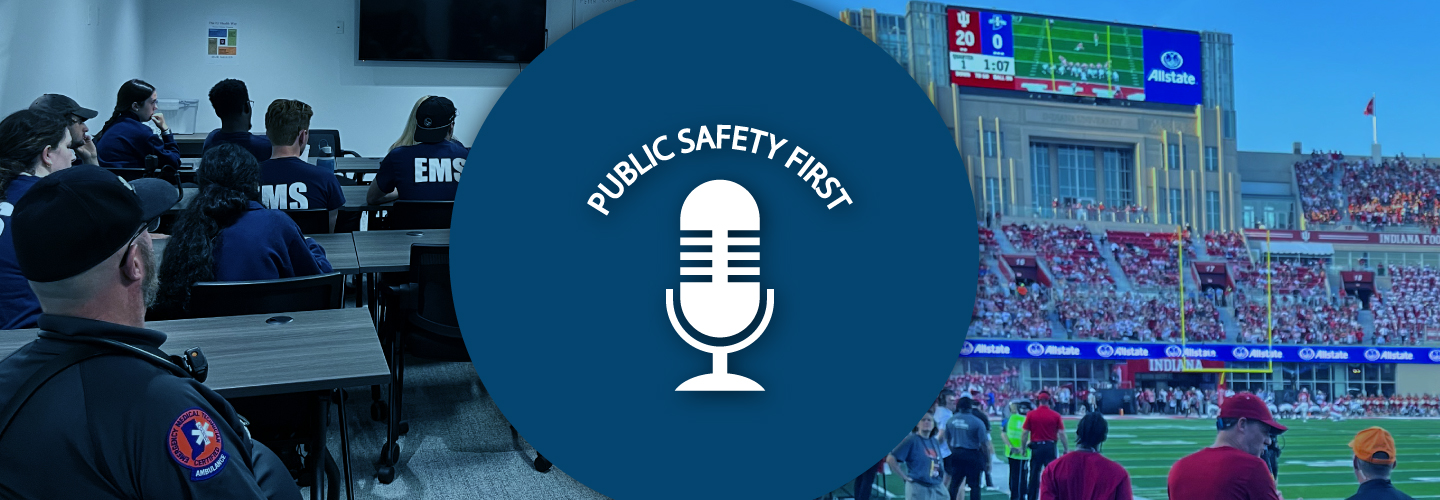
Charles Hardnett: Welcome to the Public Safety First podcast. I'm Charles Hardnett, Senior Public Safety Advisor at the First Responder Network Authority. Today I'm honored to be joined by Dr. David Rodgers and Adhitya Balaji from the Intra-Collegiate Emergency Medical Service at Indiana University, also referred to as IC-EMS. IC-EMS is a student organization comprised of certified EMT basics and first aid personnel. They're all passionate about patient care. IC-EMS is utilized by university departments, student organizations, and community organizations to provide comprehensive emergency medical care at events. I have had the pleasure of working closely with both of our guests for the better part of a year now on pre-planning for the organization's use of FirstNet for IU's football games. We are so honored to have both of you on the podcast today. Thanks for joining. So, David, I’m going to start with you. Tell us a little bit about yourself and your role with IC-EMS.
Dr. David Rodgers: So, my role with IC-EMS is I am the Faculty Advisor. I have a faculty position in the School of Medicine here at IU, and I also run our Interprofessional Simulation Center. So that has got me connected in with the group. As far as EMS goes, I've been in EMS since the early 1980s. I became a paramedic in 1985. Before that, I was an EMT in 1983. And so, with that, I've seen the evolution of pre-hospital communications going from VHF radios on into the more advanced UHF and trunk frequencies that we have today, and the entire advent of the cell phone, over my career from when there wasn't one until we have the technologies we have now.
Charles Hardnett: Thank you. And, Adhitya, I'm going to now turn it over to you. Please share a little bit about your role with IC-EMS and what your interest is in the EMS field.
Adhitya Balaji: Yeah, happy to. So, within IC-EMS, I currently serve as the Graduate Advisor. I started in EMS during my freshman year as an undergraduate at IU Bloomington in IC-EMS leading up to my senior year, serving as the Agency Chief. Throughout the years, my interest in EMS has increased, particularly in regard to education, mass gatherings, and disaster preparedness. Now, currently in my third year of medical school at the IU School of Medicine, my involvement in EMS has focused on quality assurance and developing working relationships with both local public safety agencies in Bloomington and other collegiate EMS agencies nationwide. Outside of IC-EMS, I serve as the Co-Director of Journal Operations for the Journal of Collegiate EMS and in Quality Assurance and Education for IU Health Lifeline, supporting 9-1-1, inter-facility, and critical care ground and air teams.
Charles Hardnett: Excellent, thank you. So, you know, I gave a brief introduction for what IC-EMS is, and you've talked a little bit about it, but I want you to paint a picture for all of our listeners to show just how important your work is to everyone on campus.
Adhitya Balaji: Absolutely; so, IC-EMS is a fully student-led organization—from the people working the events to the ones writing the protocols, writing our contracts, getting insurance. This is a fully student-led organization under the advice of Dr. Rodgers and our Medical Director, Dr. Waters. So, all of our students typically come in with little to no clinical experience and IC-EMS trains them to provide event coverage at both IU and Bloomington community events.
Charles Hardnett: Very nice. How many students do you have and how many are undergrads? How many are graduate students?
Adhitya Balaji: A majority, if not all, of our students are undergraduates. We typically have…I think I might be one of 2 or 3 graduate students involved in the organization. But our membership is around 100 students, again of varying experience levels and involvement, ranging from first aid providers who we help certify ourselves in first aid and CPR through the American Heart Association to EMT basics. Of those 100, around 20 a year serve as our field supervisors and executive board members.
Charles Hardnett: So, what kinds of incidents do you typically respond to?
Adhitya Balaji: Yeah, so, IC-EMS's main role is providing event coverage for IU, the Bloomington community, and beyond. So, we provide services at a wide variety of events on campus, and it's really become our niche. From large gatherings, such as IU athletics for both football and basketball, and the Little 500, which is a unique bike race to the Bloomington community. We also cover small events, such as weddings and student-led organizations that put on concerts, or smaller events that just need a little bit of EMS coverage. We pride ourselves on providing emergency services to organizations of all sizes and being truly accessible to everyone. I view IC-EMS's role to be one of three parts. As we've discussed, event coverage is a huge part of this. However, we are one of the few agencies in the area that also heavily focuses on public education and training through our CPR and first aid courses, which has led to partnerships with organizations such as Habitat for Humanity and the local Busker Chumley Theater. IC-EMS also organizes an annual mass casualty drill with local agencies, which, Charles, you were able to join us for last year, and this really provides an opportunity for all of these agencies to work together and practice our emergency action plans for various events. And the last part of IC-EMS is through our partnership with IU Red Lab, which is a crisis technology research group based at the Luddy School of Informatics. IC-EMS has been on the cutting edge of technology research, which has led to both publications and presentations at national conferences.
Charles Hardnett: As you know, within the FirstNet Authority we have a very unique program here where we dubbed it as the Network Experience Engagement Program. And what we do there is we help public safety agencies operationalize broadband technologies. Specifically, we do this through the pre-planning support, post event review, and training and exercise assistance. We also have helped several public safety officials and agencies with pre-planning for lots of large, planned events. Some of those include the Super Bowl, F1 races, state fairs and other community fairs, and so many other types of events. Pre-planning is a key information gathering initiative for us, and it helps us with any of the planned events. During the pre-planning process, we help public safety determine and document where responders will be operating during the event, but we're also looking at the broadband capabilities that they plan to use during the event and what types of other technologies they may also need. And so, the FirstNet Authority held a similar kind of meeting with IC-EMS, and we provided some pre-planning support ahead of the football season. And so, I wanted to go into some other questions that really take us into the football games, and let's talk about the role of IC-EMS at the football games for this past season, which was a really great season for you guys. Adhitya, what's your thoughts on that?
Adhitya Balaji: Yeah, like you mentioned, it's been a historic season, especially with the recent achievement of Fernando Mendoza winning the Heisman Award. IU has really had a stellar season, which is great for the community, but has also led to some strategic opportunities to expand EMS coverage at IU football games. Historically, IC-EMS supplemented stands coverage with IU Health Lifeline at these football games and in the first aid rooms. But over the past couple seasons, with our recent success under the helm of Coach Curt Cignetti, we've realized that we really need to expand how we're utilizing and think about how we're utilizing EMS at these events. So, this has led to the expansion of IC-EMS staffing, roaming, basic life support, golf carts that provide coverage for both the immediate athletic facilities of Memorial Stadium and Simon Scott Assembly Hall during football games, but also helped cover the tailgate fields across the street for patrons who may not actively be coming into the game as well. This has also led to an expansion of our role within the first aid rooms in partnership with the IU Student Health Center and IU Athletics. So, in these rooms, we have our first aid providers initially screening our patients to determine the level of care that they may initially need in direct communication with our Emergency Operations Center or, sorry, our game day operations center hosted offsite. And we have also led to partnerships with IU Athletics and staffing and EMS physician that's on site for most of these games. I think the largest addition that we've also noticed, which was really not something we were expecting for this year but was really beneficial, was the addition of an IC-EMS representative in the game day operations center providing unified EMS command alongside our IU Health Lifeline command personnel to provide unified EMS coverage at IU football.
Charles Hardnett: Okay. And so, in terms of planning, preparing for this year, how much time do you think it took you all to do that?
Adhitya Balaji: Yeah, this is a great question that I've been thinking about myself for a while. And I think really the initial planning started even before the 2024 season concluded. We haven't necessarily had to think about EMS coverage in a unique way to provide and accommodate all of the increase in expected attendance due to the success of IU football. It led to meetings with IU athletics talking about how we can expand EMS coverage, potentially expand coverage without necessarily increasing staffing through technology and partnerships with IU public safety.
Charles Hardnett: Last spring we had to do a little work to ensure that you all had access to FirstNet because we had some challenges there. And so, I want to ask, Dave, how did you all end up using FirstNet? And why did you decide to look into using the network?
Dr. David Rodgers: Well, as Adhitya mentioned, we had a dramatic increase in attendance at the football games, starting in 2024 and extending through this season. Sellouts were not common prior to this. Now we are selling out, and actually, as Adhitya mentioned, there's people hanging out in the parking lots just out there to watch from a tailgate perspective. So, we increased the crowd size by probably 25 to 30,000 per game. And with that, all these people come with cellular devices, and they're transmitting pictures, videos along with their regular cell phone calls. So, bandwidth access was becoming a priority for us, particularly in light as we were trying to roll out new technologies such as the TAK system that Red Lab was using to give us better situational awareness of our teams, particularly as our teams expanded. So, with the capabilities with FirstNet, with priority and preemption, we wanted to make sure we had the best communication possibilities we could do in order to make sure the teams could talk with each other and talk with the command center. So that was really a big driver for us. The TAK program gave us the capability of having better geolocation of crews on both an X and Y axis, as well as Z axis in a vertical world. And we're able to dispatch resources more efficiently and take care of patients, just better and faster. So that was a big plus for us this year. Looking at just looking at the general connectivity issues, just being able to get a cell signal when we had so much going on—Memorial Stadium is a big concrete structure, so penetration into the stadium can be difficult. There are dead spots, particularly if you get into the concourses and areas like that. So, we had coverage issues. We had prioritization issues, just being able to get to the network as we needed. We also did a shift this year in which we have on-site medical control, and we use that with primarily cellular telephone connections. So, Dr. Waters is available on site. Medical crews call him directly in order to get medical advice, medical orders, or sometimes even have Dr. Waters talk to the patient in order to give them advice on whether they should be transported to the hospital or not. So, with that extended capability and extended responsibility that we had, connectivity was paramount. And FirstNet offered a way to help us with that.
Charles Hardnett: That's awesome. There's one thing I want to clarify for listeners: so, TAK is the Team Awareness Kit, correct?
Dr. David Rodgers: Yes.
Charles Hardnett: Yes. And so, this is a government produced product that was actually born out of DOD, Air Force more specifically, and is actually used in the combat theater. But it has grown in traction in public safety over the past 3 or 4, 5 years since I've been tracking it. So, I'm curious, when did you all first come across TAK?
Dr. David Rodgers: So Red Lab, which as Adhitya mentioned a very good summary of what they were with the School of Informatics here at IU…did they approach us or did we approach them? Where did that come from?
Adhitya Balaji: Yeah, so, Dr. Waters initially started working with them, I think, in 2024 and he made the connection between IC-EMS and Red lab. And so, we started talking about ways that we could potentially utilize TAK, specifically at larger special events such as IU football, and this led to some partnerships between Red Lab, IC-EMS, Lifeline, and also the Indianapolis Fire Department providing some resources, specifically in terms of hardware.
Dr. David Rodgers: And that really helped out a lot for us with deploying the TAK, and TAK is taking advantage of that broadband connection. And without FirstNet resources, we would not have a stable signal to have 100% reliability with the system. But with the TAK system, our field crews, particularly the roaming crews where trying to find even one of your other units out in these vast parking lots can be difficult, with TAK, we're able to see where that unit is and just drive straight to it with the golf carts or bikes or whatever resource we have responding. So that was a big, big plus for us in order to keep track of things. We also used it for other things, such as geolocating where our incidents were to create heat maps, how we should deploy coverage in the stadium and in the parking lots and tailgate lots. So, there was a lot of versatility to it, but it was all dependent upon connectivity.
Adhitya Balaji: I think another example of how we use FirstNet that just came to mind was IC-EMS purchased four phones that were on the FirstNet network, and all of our golf carts had these phones in addition to Doctor Waters having one for medical control. But the one thing that we didn't really think about that was really beneficial was IC-EMS carries cardiac monitors. And in the State of Indiana, EMT basics can take an EKG, but it has to be transmitted and interpreted by a paramedic or a physician for them to be actually able to use the EKG. So, the nice thing with having our phones was we were able to turn on the hotspot, connect our cardiac monitors to them, and we actually did multiple EKGs on multiple patients throughout the season. And every time we would do an EKG, it would be automatically sent to Dr. Waters as an email attachment so he was able to actually view the EKG in live time and provide interpretation and feedback to the crews on next steps, which would have been impossible without the support of our FirstNet devices and utilizing the hotspot on the phones.
Charles Hardnett: That is an excellent use case. I want to circle back a little bit to the preplanning, you know, because we did do this preplanning with you guys. Dave, I'll start with you. So, can you talk a little bit about what you got from that pre-planning exercise that we did?
Dr. David Rodgers: Okay, so as we look at the support that FirstNet gave us through the pre-planning and also all through the operations aspect of this, it's been pretty exceptional. We've had good accessibility to FirstNet teams. We had excellent suggestions for deployment ideas. You've got, FirstNet has built some experience in this already, and were able to really help us, particularly as we started investigating the rapid response push-to-talk functions with some of the capabilities within FirstNet's hardware side. So just the accessibility, the helpfulness, the advice we got was really just top notch. Just the resources we were given through FirstNet really opened our eyes up to see what we could do in order to solve some of our bandwidth issues.
Adhitya Balaji: I think the other point to make is that through IU public safety also being proactive. This past season, we had a COW that was deployed to public safety and FirstNet at all of the games, which really made a huge difference in our connectivity.
Dr. David Rodgers: Yeah, and another big help was we already had some communication resources, including personal cell phones from the members. And FirstNet worked with us very well to adapt what we already had with our existing systems and make FirstNet work with it.
Charles Hardnett: That's great. Okay, so, Adhitya, let’s talk about being able to do communication between an IoT device, like the diagnostic devices that you had, and transmitting that data to medical personnel.
Adhitya Balaji: With this increased attendance, our crews are very busy taking care of patients. And typically, when we think of EMS and first responders communicating, it's through radios. And so, all of our crews had radios which connected them back to the command center. But the issue is that they become so busy taking care of their patients, it's hard to keep track and communicate with them over the radio and also expect for them to respond to the command personnel because they're taking care of these patients. And so that really leads to a lack, or, I guess, a pause in situational awareness. But with this FirstNet connectivity and through the use of tech, we could kind of guess where our crews were and their statuses based off of tech and also drop pins to locations. And the nice thing that we used through FirstNet and TAK is everyone had the same maps. IUPD was using the same maps that EMS was using, and so if they had a patient, they could tell us which quadrant on the map they were at, and EMS could just tag that on our phones and then they could go to them. Otherwise, it's just “we're by this person wearing the red and white shirt.” Which person? That's everyone at the game. And so, through the use of the same maps and these tools, it really led to a better response from all of our crews.
Charles Hardnett: Alright, so a question for both of you about lessons learned from this experience using FirstNet and at the football games: What lessons would you share with another collegiate EMS program or agency? What would be some of the best practices to share with them?
Dr. David Rodgers: Well, one thing I'd say is, even though we're talking specifically about IC-EMS and collegiate EMS, this has application to anybody with large gathering emergency medical services response capabilities. So, anyone from federal, state, local governments that have that level of response for major events can take advantage of what we learned from this and how we used it. But I think really having a good understanding of what is available to augment our existing systems, to make us run as efficiently as possible, to deliver the best and most timely patient care possible, is essential. And FirstNet has done a good job at helping us along that path. It was a great connection. I'm sure that a lot of EMS agencies or other public service agencies aren't aware of the capabilities that are available to them through FirstNet. So, I really think this has a good opportunity for us to continue our working relationship and continue planning for the future, but for other organizations to really get involved in this.
Adhitya Balaji: I think my…we've kind of talked about this before, but it's engaging you guys early. So, this process started before the 2024 season even ended and, I think, Charles, we had early conversations back then before we initially met with IU Athletics. And continuing to engage you guys early on was something that we were very grateful for. I mean, we started this more than a year in advance, and it still felt like sometimes we were changing things last minute and making sure that you guys were already up to speed helped us out a lot, especially with collegiate EMS. It's a very unique situation. There's no one solution for every college campus. And I think that's the cool thing with collegiate EMS, is it doesn't really, it's not cookie cutter. Collegiate EMS fills gaps in the communities they serve, whether that be transport, event coverage, education. So, there's no real way of predicting what collegiate EMS does. And a particular issue we ran into early on was eligibility. IC-EMS provides this emergency medical coverage at these events and works with our law enforcement and other EMS partners. However, there's no real group that collegiate EMS necessarily fits into for eligibility and so having the support of the FirstNet Authority to help us navigate the eligibility for FirstNet was huge. I don't think we could have gotten through this football season without the coverage that was provided.
Charles Hardnett: You know, this has been great. I actually learned a lot. And so, I look forward to, as you all learn more about the network, more about applications and devices and so forth, finding additional use cases for the network. But are there any other ideas that you want to share?
Adhitya Balaji: I think utilizing collegiate EMS as a use case is huge, especially for technology. Collegiate EMS is uniquely positioned for research and for using these newer technologies with their academic ties. And I really hope that other collegiate EMS agencies start to buy into this a little bit more and reach out and use new technologies and position themselves as leaders and not just collegiate EMS, but EMS as a whole to expand where we are at currently and challenge ourselves.
Charles Hardnett: Thank you both for taking time to speak with us. And it was definitely great speaking to both of you, and I look forward to working with you in the future.
Dr. David Rodgers: Okay, we appreciate you having us here today.
Adhitya Balaji: Thanks, Charles.
Narrator: Thanks for listening today. We're excited to have you join our podcast community. Make sure to subscribe on iTunes, SoundCloud, and YouTube. You can learn more about the First Responder Network Authority at FirstNet.gov and learn about FirstNet products and services at FirstNet.com.