


This blog is a repost from Healthcare IT Today, originally published on August 6, 2026.
How does a hospital system restore life-saving communications after a cyberattack or during a planned fiber outage?
For Maryland Healthcare Coalition Region V, the answer is a robust, layered communications capability anchored by FirstNet, the nationwide public safety broadband network.
In healthcare emergency management, ensuring resilient connectivity across a complex healthcare ecosystem is essential to delivering patient care.
“Without communications, nothing else works,” said Paul Bowling, Emergency Manager at University of Maryland Capital Region Health and Vice Chair of the Region V coalition. “When communications fail, pretty much everything else fails.”
A regional model for preparedness
Maryland Healthcare Coalition Region V operates within a statewide framework of healthcare coalitions designed to strengthen preparedness, response, and recovery across jurisdictions. Serving the National Capital Region and five counties in southern Maryland, Region V supports a highly interconnected healthcare delivery system where disruptions can have immediate and widespread consequences.
The coalition integrates a variety of healthcare providers and public safety agencies into a coordinated response network. “We work together to bring better care to the community,” Bowling explained. “It’s not only hospitals — it’s public health, nursing homes, rehab facilities, dialysis centers, and our partners in fire, EMS, emergency management, and law enforcement.”
For healthcare providers, communications are inseparable from patient care.
“For the patients, it’s a matter of life and death,” Bowling said. “Keeping that information flowing is key — that’s the bottom line of what we do.”
In recent years, the coalition has shifted its focus from purchasing equipment to building sustainable, interoperable capabilities.
Operationalizing a ‘network of networks’
Capabilities — rather than just equipment — need a network to function. FirstNet is a nationwide broadband network operated by AT&T and overseen by the First Responder Network Authority, a federal agency. It is embedded in operations for public safety officials nationwide, including those within Region V.
“My day-to-day phone is FirstNet,” Bowling noted. “All of the leaders within Region V have a FirstNet phone.”
Region V has implemented a layered communications strategy that is grounded in interoperable, resilient public safety communications.
This “network of networks” includes FirstNet-enabled smartphones and mobile data, deployable cellular systems, satellite connectivity, Wi-Fi-enabled communication response devices, and legacy systems such as amateur radio and GMRS, or general mobile radio service.
“We have a complete system now,” Bowling explained. “It would have to be a pretty bad event, like an EMP, to knock what we have out of service.”
Within this architecture, FirstNet serves as a critical backbone, supporting both direct communications and acting as backhaul for Wi-Fi and other systems.
“We’re able to provide Wi-Fi and use FirstNet as the backhaul,” he said. “That gives us the ability to keep systems running even when primary networks are down.”
Seamless restoration of communications during cyberattacks and outages
Region V’s approach has been validated through multiple real-world incidents.
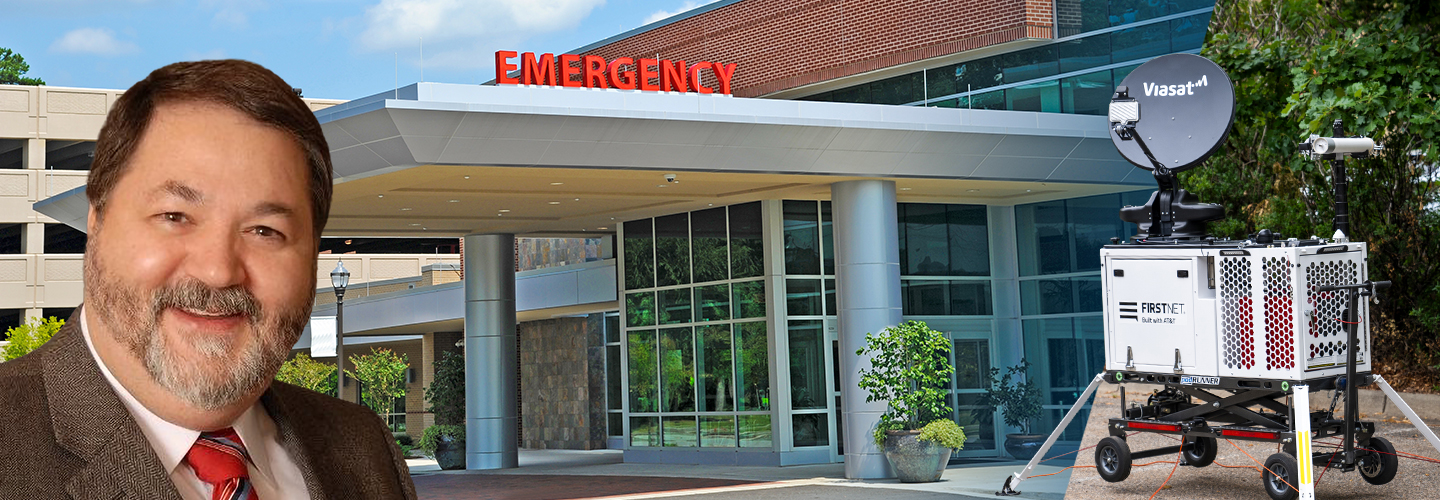
When a cyberattack affected a Maryland hospital in early 2025, Region V deployed its communications cache of FirstNet-enabled devices and a compact rapid deployable (CRD) to restore connectivity. The CRD is a portable mobile cell site that provides up to one mile of broadband connectivity via satellite.
With FirstNet devices distributed and a connection established via the CRD, hospital staff were able to maintain operational communications when traditional systems were compromised.
Later that year, Region V prepared for a planned fiber outage at a different Maryland hospital. The outage would affect core hospital systems, including electronic medical records. Using FirstNet, the team forwarded hospital phone systems to FirstNet devices, re-established Wi-Fi connectivity through the CRD, and maintained access to clinical systems.
“We had essentially seamless downtime,” Bowling said. “All the phone calls that were coming in and out of the hospital were answered, and we could still keep track of patients and medical records.”
Just a few months later, a construction accident severed a major internet line, and the same hospital lost all communications. “We went down — everything,” Bowling recalled. “There were no communications.”
Within two hours, FirstNet technologies restored operations.
“In a hospital, communications are key — whether you are trying to access lab results, give orders, share critical data, or get a specialist like a surgeon involved,” Bowling explained. “If you don’t have communications, none of that can happen. It becomes very difficult to an already overwhelmed system, and then things start backing up.”
With deployable technology solutions, Region V has been successful in bringing hospitals back online within hours. This can have life-saving impacts.
Scalable and interoperable: Driving adoption through usability
Region V has extended its capabilities to other healthcare coalitions across Maryland, demonstrating the scalability and interoperability of its approach.
“We’re not trying to keep this just for Region V,” Bowling emphasized. “We want to share our capabilities.”
Ease of use has been a critical factor in adoption.
“At one incident, I ended up handing out a bunch of portable radios, and no one knows how to use those things,” Bowling said.
By comparison, FirstNet-enabled smartphones required minimal training and were quickly embraced — people use this kind of technology every day.
“They loved the fact that we were using it, and it worked,” Bowling said.
Expanding capability and sharing lessons learned
Region V continues to advance its communications strategy, exploring the integration of FirstNet with two-way radio systems and expanding Wi-Fi coverage and in-building connectivity. The group has also enhanced its use of deployable network assets and standardized procedures for rapid deployment.
Equally important is sharing these lessons across the broader healthcare and public safety community — because in healthcare emergencies, connectivity is not optional. It is essential.
To learn more about FirstNet and how the network is supporting emergency communications, please contact your senior public safety advisor at FirstNet.gov/advisor.