Summary
Guest
Brett Johnson, Senior Public Safety Advisor, FirstNet Authority
Josh Keliikoa, Public Safety Manager, Rincon Band of Luiseño Indians
Josh Ellison, EMT-I, NREMT, EMT Recruiter, Navajo Nation Emergency Medical Service
Jasper Bruner, Chief of Police, Nisqually Police Department
Transcript
Preview
Narrator: You're listening to Public Safety First, a podcast to help you learn about the First Responder Network Authority and how you can be part of the future of public safety technology.
And now, your host.
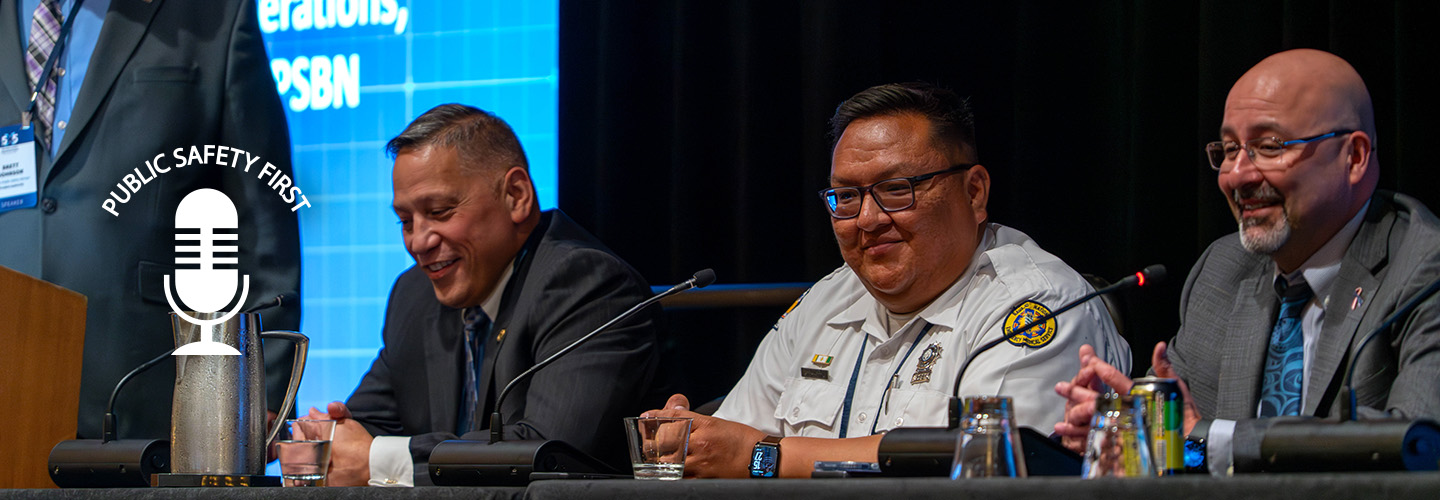
Brett Johnson: Welcome to the podcast. I’m Brett Johnson, a senior public safety advisor at the First Responder Network Authority. This episode you’re about to hear was recorded live at 5x5: The Public Safety Innovation Summit held in June 2025 in Bellevue, Washington.
Narrator: You're listening to Public Safety First, a podcast to help you learn about the First Responder Network Authority and how you can be part of the future of public safety technology.
And now, your host.
Brett Johnson: Welcome to the podcast. I’m Brett Johnson, a senior public safety advisor at the First Responder Network Authority. This episode you’re about to hear was recorded live at 5x5: The Public Safety Innovation Summit held in June 2025 in Bellevue, Washington.
I had the opportunity to meet with leaders in tribal public safety to discuss the unique challenges and opportunities involved in implementing public safety broadband communications across tribal nations. I was joined by Josh Keliikoa, public safety manager for the Rincon Band of Luiseño Indians, Josh Ellison of the Navajo Nation EMS team, and Jasper Bruner, Chief of Police for the Nisqually Tribe. We had a great conversation about the real-world deployment of FirstNet within their tribes, and how FirstNet is helping tribal communities become safer and more connected. I hope you enjoy the conversation.
We have an esteemed panel here today, and we're really happy to have them. So, first a quick “by the numbers” for FirstNet and tribal communities. The last numbers that I got from our FirstNet AT&T team — over 320 tribal agencies utilized FirstNet with over 36,000 connections. And there are 575 new towers serving tribal lands since FirstNet went live with an increase of coverage by 64%. We still have a lot of work to do, and we're happy that people are here. We want to get your feedback on what's working and what's not.
With that, I want to thank our panelists, Jasper Bruner, Josh Keliikoa, and Josh Ellison. We'll have the panelists introduce themselves and describe their diverse roles in public safety in Indian Country. I'd be remiss if I didn't mention that until February [2025], Jasper Bruner was our tribal liaison for the FirstNet Authority, and we really miss him. But he left to become the police chief for the Nisqually tribal police. So, he’s certainly being well used in that world. And we're glad that he's still a friend and is able to serve with us. So, I'll start with Josh Keliikoa on my left. Can you introduce yourself and describe your roles in public safety?
Joshua Keliikoa: Well, first off, I appreciate everyone in the room and seeing your bright and shiny faces today. So, Iokua Pele Keli’ikoa Sagapolutele. So, my name is Joshua Keliikoa. I'm a native Hawaiian. I come with a pretty amazing background. Thank you, U.S. Army. Being that, I was also federal law enforcement — oversaw, not just patrol. I oversaw criminal intelligence operations. I've been with some of the alphabet agencies out there. Now, I support emergency management, oversee fire and law enforcement for the Rincon Band of Luiseño Indians.
Josh Ellison: Good afternoon, everybody. My name is Josh Ellison. I am with the Navajo Nation Emergency Medical Service. Currently, under the Division of Public Safety. So, my background is mostly EMS. For about the past year and a half, I was reassigned to our emergency management under our task force. So, currently I am serving under an administrative role. So, I oversee our recruitment, public relations, employee relations, and our hiring process. So, very happy to be here.
Jasper Bruner: Good afternoon, I'm Jasper Bruner. As Brett had already said, I'm the chief of police for the Nisqually tribe in Olympia. I've been in Indian Country law enforcement for 23 years. Took a two-year break with the FirstNet Authority. I've served everything from patrol all the way to the chief of police.
Brett Johnson: All right. This question will go to all three. What communication challenges do you face in your tribal community, and how does FirstNet play a part in your daily operations? Start with Josh Ellison.
Josh Ellison: So Navajo Nation is, geographically, the largest tribe in the United States. So, we cover about 27,000 square miles. So, it's a little bit bigger than West Virginia, spanning over southern Utah and northern Arizona and northwestern New Mexico. Needless to say, it's a very rugged rural terrain. And so, connectivity has always been an issue. When I started EMS 13 years ago to now, its a big, big change. A big improvement thanks to FirstNet. I know they put up a little bit over 60 sites across Navajo Nation — definitely connecting us better with the hospitals, our dispatch, and other units in the area. So, big improvement on Navajo.
Brett Johnson: All right, we'll go to Jasper.
Jasper Bruner: Well, I can't say my land base right now is that big. I got eight square miles to cover, but I do have a casino within my jurisdiction and area. One of the unique things about the Nisqually tribe is that their U&A — their usual and accustomed area — ranges from the port of the Tacoma Narrows Bridge all the way down to the Columbia River. So, our usual custom area is very large, and within that area there's a lot of communication gaps. But FirstNet has evolved in that point to where our land patrol base on the reservation is very well covered. It's the other areas that are problematic that we're going to get into in a little while, which includes the waterways, and then those very rural areas from Mount Rainier all the way over to Olympia, and then down south towards the Columbia River.
Brett Johnson: All right. And, Josh Keliikoa.
Joshua Keliikoa: So, with the Rincon Band of Luiseño Indians in Valley Center, California, some of our unique challenges — we're in the shadow of the Palomar foothills and the mountainous ranges. And being in California and fire country, it's very challenging. We also run a inter-tribal service for ambulance service between the La Jolla reservations, Palma, Paula, and San Pasqual, but also support the surrounding communities.
So, it's a holistic approach for just not tribal, but the non-tribal communities we serve. And having the uniqueness of that is it challenges us not just to your standard TDMA [Time Division Multiple Access], but making sure our CAD [computer-aided dispatch] is available for updating information and for our responders out there.
So those are unique challenges. But all of our folks at Rincon utilize FirstNet for their duty cell phones, for our multiple divisions and departments that support tribal government operations, ultimately serving our tribal membership.
Brett Johnson: All right, next question is, have you requested or used a FirstNet deployable solution for a pre-planned event or emergency, and if so, please describe the process and your thoughts on the program. We'll start with Jasper.
Jasper Bruner: Mine was very unique. Four months into the first AT&T tower build on the reservation in Makah, where I was formerly the chief of police, during the winter storm, everybody lost signal. We're like, what's going on? Took a ride up there and the actual tower collapsed. It was brand new. Four months in, and in that process, I reached out to the FirstNet Authority — send out a deployable. So at least our fire department and police could have some kind of signal, because we had migrated at that point in time over to FirstNet, so we were 100 percent dependent on it.
But FirstNet and the deployable program sent out a COW [Cell on Wheels]. We deployed it. We had access and communications during that time. It was an eye opener because I did not have to fight with the carrier. I didn't have to fight with anybody. They recognized the problem.
So, when I came on board, I got to relay that story to many other different people, many different organizations, that they were taking care of us as individuals and customers, but we were prioritized over the customers in order to ensure that we had communications.
Brett Johnson: Josh Ellison.
Josh Ellison: So, the deployables that Navajo Nation use, we use them all the time. We request them every year. So, where I'm from in Shiprock, they have the Northern Navajo Nation fair. But it's a small community, about 30-40,000 people. But literally overnight in the weekend, it goes to 450,000 people.
It's a multi-jurisdictional event. So, it's not just Navajo Nation. We have Farmington police coming out. We have New Mexico State Police coming out. We have Ute Mountain coming out. The Jicarilla Apache comes out. So, there's a lot of agencies that come in. And so, when we requested the deployables, we set up next to our emergency operations center. But super helpful, very simple to request, actually.
But it's not just that fair. We had a pretty bad snowstorm to where we had to rescue literally a whole community out of an area. FirstNet was there. Their equipment helped us stay connected. So Navajo Nation, we do use it.
Brett Johnson: Very nice. Josh Keliikoa.
Joshua Keliikoa: So, just tie this up very shortly and round this out. I think in looking at national special security events and those type of things that we have out there are some of the things that I've got to deal with. But on tribal nations, I saw a need for a current wildland fire exercise that's in the North Zone and San Diego County. I saw that our COML [Communications Unit Leader] was not good down there for supporting FirstNet operations. So, my new course of action for the new exercises is that we will put a ROG [Response Operations Group] request in to support a training exercise for practical exercise out there. So, I saw the need. It was too late to get around that, put a request up. But for future planning, we will definitely put that request in for a new course of action.
Brett Johnson: Thank you. And I've used it — actually worked with the Cow Creek, where I came from before. And they had a pow wow that they would have every year. First, two full weeks on Forest Service land 25 miles from the nearest cell tower. A lot of folks there, it's in the middle of the summer in the Cascades. Wildland fire danger is high, and there's very limited resources up there — no coverage. And then the first year that they put in for a deployable, they took a CRD [compact rapid deployable] up there. And within the first day they had somebody uninvolved with the pow wow, go off the road, car full of kids — multiple injuries, had to be airlifted out, and started a wildland fire. And the chief was really appreciative that they had it there. He was able to contact dispatch. He was able to talk to the medical providers and be able to have that communication level that he would have had in town. So, that was a good use case.
Next as technologies evolve, we see satellite-to-device options coming out shortly for beta testing. How would the addition of satellite-to-device providing text, data, and voice to your toolbox impact your public safety operations in rural tribal areas? And we'll start with Josh Keliikoa.
Joshua Keliikoa: I think that's a great question. And especially in our areas it would be highly utilized because that white space — we'd fill the gaps there. Definitely. The public safety issue is that some of those areas just cannot reach, even with an HPUE [High Power User Equipment] in those areas, to facilitate connection to our mobile data terminals out there. And with terrestrial like that, it would solve more issues to be able to provide those services needed. And I know as other regions out there, that would be a force multiplier for quite a bit of tribal nations.
Brett Johnson: Thank you, Josh Ellison.
Josh Ellison: So, the satellite capabilities on Navajo Nation — definitely beneficial in the areas we still have dead spots, mostly in the valleys or the canyons. Right now, we're reaching peak tourist season on Navajo Nation. For some reason, even though we put out PSAs [public service announcements] to tell our tourists stay on the road, don't believe your GPS, they still end up off the beaten path.
So, last month, we actually did a rescue of German nationals who took a big old army truck into the mountains. And it's a miracle that they were found because where they were at was no cell service at all. So, the guy had to hike up to ten miles up the mountain to finally get cell service to call for help. FirstNet was definitely a help, but we had I don't know what the machine is. You put in the back of your truck, you hook it up to your…
Brett Johnson: CRD?
Josh Ellison: Yeah. That one. Yeah. So that's what was deployed because it was a small area that we needed it for. Definitely helped with the cell service, but I think satellite capabilities where we found that truck, that would have been great. Drones would have definitely been helpful to that for the operation, but satellites definitely be beneficial on Navajo.
Brett Johnson: Jasper.
Jasper Bruner: Where I'm from, we are outside of a lot of terrestrial communication signals. Our fisherman fleet, we have 1,500 square miles on the straights and the open ocean. So, we're used to dealing with satellite phones. We know how reliable they are. We know how unreliable they are. When it comes to land-based using that technology, the old technology is we're too far north. Our partners in Alaska, they run into that same problem, they're too far north. So, connectivity is not usually there. We still have them, it's a form of emergency communications. But to have that available in areas like Josh had mentioned — the wayward campers, hikers, all of that stuff, most of our rescue areas out there, there is no communications. It's line of sight, it’s radio communications at best to have that, but to have immediate satellite communications, that connectivity that's there once you get outside of that bubble of LTE [Long Term Evolution], 5G, any of those other communication technologies to where you can use that satellite, that is a game changer — especially for our first responders that are going out to these very rural areas, on reservations, making those rescues.
Brett Johnson: Jasper, can you talk about the importance of connectivity, especially with an MDC — mobile data computer — for the first responders and how, you know, disconnections can cause mayhem with first responders?
Jasper Bruner: Absolutely. Here in the state of Washington, we have a great technology base with our first responders. A lot of tribes across the nation do not have that ability, but we join and partner with our state and local agencies to have that instantaneous access to information. Our medical services are starting to evolve in that same direction, but to have that connectivity is something that was missing forever because you could have the MDTs [mobile data terminals] or the mobile computers enter the information, but you'd have to find a hotspot of Wi-Fi or something.
Now, with the integration of FirstNet, just about wherever we're at, we can have that connectivity and that instant access to information has saved so many officers’ lives because they got the notification. When they ran a vehicle, there was a warrant attached. That person's dangerous. But the services that FirstNet has brought in partnership with AT&T has only given tribal nations more and more, which we've never had, which we try to build off of every year. And that's the importance of these partnerships and our interactions in these partnerships is that we have a stake in it. We have a stake in what they're doing, what they're saying. We can tell them what we think, and then ultimately, they'll make the decisions. That's going to help not only our nations, but other tribal nations across the U.S.
Brett Johnson: Thank you. Now, back to you, Jasper. Have you deployed High Power User Equipment or Mega Range in your jurisdiction? And can you describe how that has impacted your communications coverage?
Jasper Bruner: At Makah, they have tested it up there. It does work. It expanded the range of the reservation up there, which is 48 square miles, land-based. Fifteen-hundred square on the ocean. It does work. Here in Olympia, I'm getting ready to deploy it in our Fish and Wildlife vehicles because they go up to Mount Rainier. They have a huckleberry harvesting, which is a big deal for the tribe, but there's no communications up there.
If you hear about rescues up there, it's all helicopter. They have to send deployables up. AT&T has been very good about sending the deployables up for the federal and state agencies. But my intent is to have it mobile in the vehicles. The other project is into our boats that are on the South Sound, near the Olympia Port, the Tacoma Port, and the Tacoma Narrows. We have a specific reason we're out there is because we have divers. So, they're out harvesting natural resources. But I want to ensure that they have the communications, because on water, you everybody knows that communications get really wonky once it gets around water. I want to ensure that it's built into those platforms, and I'm in that process right now.
So, hopefully next year I can report back that it works and it works very well and be a supporter of it. But I have to take that first step. I have to try. If not, I will come back and say, hey guys, we need to do something else. I'm willing to make that investment to ensure that my divers on the water, the general public, and my officers are safe out there.
Brett Johnson: I think I've told you in the past, but Alaska Fish and Game is actually using it just for that and having successes. Good use cases. Josh Ellison.
Josh Ellison: So, Navajo Nation DPS — Division of Public Safety — so, all of our emergency vehicles do have the FirstNet MegaRange, so our ambulances are police vehicles, our fire trucks. And just recently, Navajo Nation Fish and Game have them and they work great. Connectivity has not been an issue. We haven't had any reports of outages or things not working in our trucks, but, it works great for Navajo.
Joshua Keliikoa: So, I've done test and evaluation on our HPUE, so it does work in some of our areas, However, for the regions that we support operations in outside of our tribal nation and to another tribal nation, I've done test eval up there, and I couldn't ping anything. It is mission capable if you can hit that tower. But without the tower, that's where satellite communication will fill that white space up very well, I believe.
Brett Johnson: All right. Thank you. As we know, there's a lot of tribal gaming enterprises throughout the country. Can you talk about some of the communication challenges in and around tribal gaming enterprise properties and how some of those challenges are effectively addressed in this industry, particularly with the use of FirstNet. Josh Keliikoa.
Joshua Keliikoa: So, we're a gaming tribe. We own the Harrah's Southern California resort in California. Looking at the solutions, what we have with FirstNet and being able to talk with our casino operations, that's been a great multiplier. So, we can communicate not just through our phones, but using pads and other devices that are connected, and then also our law enforcement, because they're connected to our mobile data terminals also.
So, I count on my devices and those gaming agents, those surveillance folks that helps them be able to protect our interests, but also target potential nexuses to missing, murdered indigenous people, children, and women in our countries. Being able to also say, hey, there's an issue or we've had a child taken. Well, now I can put out a blast and talk to CHP [California Highway Patrol] and have the missing endangered person code or an Amber abduction alert. So those are some of the challenges that I see. But in gaming operation, that's what we think about and look for those type of solutions and what we utilize currently.
Brett Johnson: Josh Ellison.
Josh Ellison: So Navajo Nation has four casinos, and kind of like what Josh said, it is, I guess, a gateway for criminal enterprise. So, a lot of our casinos are right at the border towns with bigger towns. And so, the criminals know, if you go onto reservation, laws are different. They can't get tracked. You know, state, local or state municipal police departments don't have jurisdiction on Navajo. So, they bring that onto Navajo Nation.
So, our security, we work really close with all the security officers and the programs across Navajo Nation. We also work close with our gaming regulatory authority. Everybody uses FirstNet, so we're always connected. And just recently, their security was put onto our public safety frequency. So now they're able to call for help versus going through dispatch and stuff like that.
Brett Johnson: That's great. Jasper.
Jasper Bruner: Yeah, absolutely. Coming back to the Nisqually reservation, they do have a casino. They are a casino tribe. In my meeting with the casinos, pne of the first questions was, “How can we communicate together?” I said, “Well, you can't jump on our radios because we work through the county conglomerate radio system, which is called T-com, there in Olympia.” We pay for that service, it's law enforcement only. Fire has their own, EMS has their own, but the direct communications with the police, they said, “What's the solution?” I said, “Push to talk.” They're like, “What is that?” So, I sat there for 20, 30 minutes. I explained it to them and they're like, “Oh, can we do that?” And I'm like, “Yeah, it's very simple because we have a good, strong enough signal there in the area that it would suffice inside and outside the building.”
I do run into problems because the casino is older, so it was built — stick, rock, a little bit of metal — but the parking structures are all concrete and steel, and that's where we have a lot of scrupulous interactions. But our communications are degraded in those areas because it's four levels, and it's all of that concrete and metal that the signal needs to get through in order to communicate with first responders. So, we were working through that. We do have some assets through AT&T that we're looking into purchasing, deploying, and also testing in those areas. And that, for the casino, is pretty big because they're not wasting time. They can directly communicate with the supervisors on patrol with the supervisors at the casino. If there's an event unfolding while somebody is calling 9-1-1 to help shorten that response time to possibly save a life or save somebody from being hurt, including my officers.
Brett Johnson: Thank you. I think we have about three minutes left. So, we want to see if there's any questions from the audience. We have a mic over here you can come up to. There we go.
Matt Schiller: I'm Matt Schiller, FirstNet Authority. First of all, thank you so much, a great session, really learned a lot. It sounds like it's coverage, coverage, coverage is king, obviously. Can you just speak a little bit about some of the challenges for building fixed infrastructure on tribal lands as far as permitting, rights of way, rules, regulations? We know how hard it is everywhere else in the 56 states and territories. I'm interested in getting that tribal perspective, please.
Joshua Keliikoa: Well, that is a great question. So, highly suggest that you partner with tribes, and here's the reason why — NEEP and Sequa are very fast for tribes. We don't have the regulations because we're sovereign nations, so that build out can be so much faster if you partner with tribes that you could be ahead in your space that you're looking for versus state, local, and other federal-owned lands, takes so much more time. But if you partner, like I said, with the right tribes to create critical infrastructure we can do it faster, still safe, but we can provide that service, right? And we're always looking to expand the public's safety network for our responders that are out there. So, a great question. But again, the bureaucracy of the tape is really not there. And I definitely highly encourage you between Jasper, Josh, and I and other tribes of all 574, please reach out. Please do.
Brett Johnson: Thank you everybody for coming. I really want to thank the panelists. We learned a lot today and we appreciate your time.
Narrator: Thanks for listening today. We're excited to have you join our podcast community. Make sure to subscribe on iTunes, SoundCloud, and YouTube. You can learn more about the First Responder Network Authority at FirstNet.gov and learn about FirstNet products and services at FirstNet.com.