Summary
Guest
Mohammad Baig, Lead Market Development Manager, AT&T (at time of recording)
Brian Hobson, Acting Assistant Executive Director of Innovation and Investment, FirstNet Authority
Chief Brian Zierlein, Division Chief, Boulder County Sheriff’s Office
Rasheid Scarlett, Board Member, FirstNet Authority Board
Transcript
Preview
Narrator: You're listening to Public Safety First, a podcast to help you learn about the First Responder Network Authority and how you can be part of the future of public safety technology.
And now, your host.
Narrator: You're listening to Public Safety First, a podcast to help you learn about the First Responder Network Authority and how you can be part of the future of public safety technology.
And now, your host.
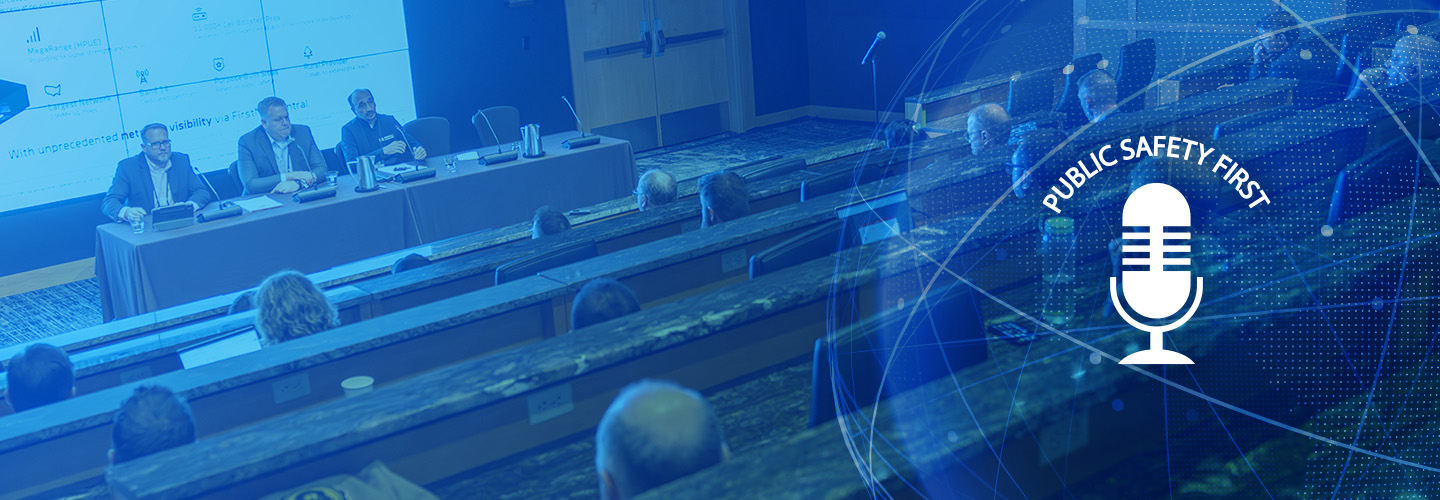
Brian Hobson: Welcome to the Public Safety First podcast. My name is Brian Hobson. I'm the acting Assistant Executive Director of Innovation and Investment at the First Responder Network Authority. In this episode, you're about to hear was recorded live at 5x5: The Public Safety Innovation Summit. I had the opportunity to be a member of a panel on the Cellular Space Race and exciting progress to date, as well as what this could mean for public safety, what's latest in the marketplace, and where FirstNet fits in. I was joined by Mohammed Baig, lead market development manager at AT&T FirstNet, and Chief Brian Zierlein of Boulder County Sheriff's Office. We had a great discussion on the work accomplished this past year. I hope you enjoy the episode and thanks for tuning in.
Rasheid Scarlett: Good morning. My name is Rasheid Scarlett, and I want to welcome you to the first of today's 5x5 breakout sessions. We'll be talking today about the Cellular Space Race. I'm a member of the FirstNet Authority Board and a Chair of Programs and Future Planning Committee. My background is in network communications, both on the federal and commercial side, and I advise leaders on the technologies that matter most to their organizations. So last year, we began speaking about the role of direct to device communications in and what it plays for public safety. We've got a powerful group here today to give you several perspectives on that. Brian is Acting Executive Director for Innovation and Investment at the FirstNet Authority. He's been with us since the start and brings 20 years of public safety communication experience. And then Brian Zierlein, who is Division Chief at the Boulder County Sheriff's Office in Colorado and brings 25 years of experience in the field, and then Mohammad Baig, Lead Market Development Manager at AT&T. He's been with FirstNet since 2017 and currently leads AT&T work on the direct to device cellular connectivity. So, yesterday I was talking to a colleague of mine, and we pretty much said that there is pretty much no point in which a first responder can go without connectivity now. That is a lifeline for what they do, and I think that's something we can all agree on. So, last year we started the conversation on where this technology is. We're going to talk about where we stand today, and where the technology is going forward. So, I'd like to start by handing the mic to Chief Brian Zierlein.
Chief Brian Zierlein: As Rasheid mentioned. I'm a big proponent of connectivity for first responders where there is no terrestrial cell coverage. Today, I'm happy to talk to you guys about the direct to cell supplemental coverage from space need for first responders.
First responders across our nation face daily challenges due to inadequate or inconsistent terrestrial cell coverage in many areas, but especially here in the western part of the U.S. Large regions have no cellular coverage at all. The reality is clear. We're never going to have enough towers installed to cover these expansive and often remote areas comprehensively. FirstNet has provided us with some great resources, like the deployables, that we can deploy as assets, but they're really not suitable for routine everyday calls for service, which is really where we spend much of our time as first responders functioning.
Emergency responses aren't always multiple day events. They occur continuously around the clock. It's important to remember that lives are saved when responders have consistent, reliable access to vital information throughout their operation. So, imagine with me, if you will, rural responders having the same real time location-based dispatching and up to date medical and call information on their mobile data computers as responders in urban areas that they take for granted every day. That consistency dramatically enhances the effectiveness and safety of our responders. True nationwide solutions must genuinely cover all areas of our country, not just the densely populated ones, which is something that we really struggle with in Boulder County. So, as first responders, our hope and expectation for SCS or Supplemental Coverage from Space is that it can bridge the significant gap in connectivity. One of the key pieces, though, is that it's essential that this solution is offered at a price point that local governments can realistically afford.
It's also critical to recognize that this transition to low Earth orbit satellite direct to cell coverage is going to take time. I have to keep reminding myself this is groundbreaking work. No one has ever attempted a dedicated direct to cell satellite service on this scale. I think what is being worked on now in this arena is something that is going to be changing the way first responders in rural areas interact with data that just keeps getting more and more important.
FirstNet stands out as the only cellular carrier willing to have meaningful, ongoing dialogues about these critical issues with first responders. Their openness to discussions really signals a genuine commitment to the needs of emergency personnel nationwide, ensuring that reliable 24/7 cellular connectivity for first responders through supplemental coverage from space is more than an innovative idea for those of us in rural areas. It's a lifesaving necessity, and by supporting these efforts, we're going to be able to empower those on the front line with the tools they need to keep our community safe.
Brian Hobson: All right. Thanks, Chief. Brian Hobson from the FirstNet Authority, and it's really my job and my team's job to work with our public safety teams, our field teams, to gather this type of feedback and then see what we can do to solve those types of problems. And this has not been a new problem that has arisen. That has been a long-standing problem.
But with the technology that's coming, it's something that there might be some great opportunity in the near term to try to begin solutions. I don't want to say solve the problem. And so, what's really exciting is this is a perfect example of how this whole process works. That we hear from the users and what they need, where their challenges are, what are their problems. We can work with them to really understand deeper and then try to figure out what solutions and opportunities there may be, so that we can bring this to public safety and begin to solve those use cases and those scenarios like Chief described. So, not only do we take the feedback, do we engage to understand deeper, do we engage with industry partners to understand who's in this space, what are the challenges? What are the risks? What do we need to make sure we do from an investment perspective to realize the outcomes? This is where the partnership with AT&T is a great example where they are pursuing this on the commercial side. So, there's work that they're already doing where we don't have to go kind of pave the way for this technology all on our own, but rather we can leverage what they've started, and then we can figure out how do we apply this for public safety and for FirstNet that's incremental to what they're already doing in the commercial side, we're not having to do this and bearing kind of 100% of that cost. So, that's kind of the whole process where we learn from public safety.
In this case, we did an innovation trial. We're able to work with our partners with AT&T to figure out what makes sense for us. This was also a good example, where we had this on the horizon for a little later off in the distance, based on the feedback we had from AT&T and based on their relationships. They said, “this is something we think we can do sooner and we might be ready to go faster.” So, we did not originally have it going this soon. We didn't think the technology initially might be quite ready, but the trip we made, the conversations we've had has proven that it was ready sooner than planned. So, we were able to make that pivot, that adjustment, and that just kind of goes to show in our programs and our processes, we want to be very responsive, very adaptive, so that we can pursue things like this as the opportunity arises.
So, really excited to hopefully be beginning some of the initial steps with doing testing on this and hoping bringing this to be a reality for public safety, but only after it's gone through the proper test and measures and we have confidence together that we think it's ready for public safety use cases. With that, I will pass it on to Mohammad to talk about the specific solution.
Mohammad Baig: Well, good morning, folks. Appreciate the time to chat with you all today. My name is Mohammad Baig, the Product Manager for this effort, specifically for FirstNet Satellite Device Services.
As Ryan mentioned, this is a AT&T wide initiative, and this is why this public private partnership is so important, because we can leverage on a lot of the work that is being done in the broader AT&T sort of sphere in regards to this, obviously, FirstNet and if we attempted to deploy something like this on our own individually, would have been quite a cost burden to absorb that probably would not be realistic, right? This is why the partnership is so important across the board to bring some of these unique things to market that we would not have been able to do otherwise, right? Economies of scale are important. This is something that is an AT&T initiative across the board. You'll see some of this work creep up in sort of the consumer space and the and the enterprise space and so on and so forth. But I'll speak to in a, in a little bit about why this is differentiated specifically for FirstNet. But before we go there, I really want to spend a couple of minutes and talk about this technology, right.
Many of you saw a lot of developments from some of our competition. You've seen this across many different verticals in terms of the device space and so on and so forth. But it's important to put this in the right context as part of FirstNet. You all have heard about us talk about the terrestrial buildout of Band 14, the terrestrial buildout about FirstNet as a whole. That is vitally important, right? That is, that is sort of the base layer of the cake, if you will. Right?
We're proud to say through the partnership of public safety and the partnership with FirstNet Authority, we're building, and we have today the largest footprint available to public safety, hands down. Band 14 is a critical piece of that, right? Band 14 allows us to offer public safety. The differentiated services in terms of high-power cell booster pros, dedicated deployable assets that you can leverage through our rogue program, that you can leverage through your own purchase. And those come in multiple different sizes and form factors. And as chief mentioned, that isn't the end of it, right? That doesn't solve all your problems. And we recognize that, right? Having deployed the network and continually deploying that network, we know there are still pockets of the country we just simply cannot cover. That's where satellite to device services will come into play.
The ground reality is we actually want you on our terrestrial network. First and foremost, that's where the best experience is. We want to make sure that to the extent that we can, we build that and invest in that network first and foremost. If that is something that is unavailable for whatever reason. It might be geography, might be terrain, it might be remoteness, and so on and so forth. That's where our goal is to drop in the Satellite Direct to Device Services. That satellite direct service will be something that at initial launch will be a communication wherein you'll get basic data, basic voice, basic messaging capability, basically to get you guys up and running. To get public safety up and communicating, get that initial attack scenario solved for from a comms standpoint, while you're waiting for those additional communication assets to be brought to bear and to be brought on scene. That's really the goal of this, right? We're going to build upon what we launched as a minimum viable product, offer some more rich data features and functions, and so on and so forth. That won't be at launch, right? The goal here is to get this service deployed in those areas where we simply can't get it going, get that sort of base built, and then in parallel, do all those other things that we always have done is build out that terrestrial network and work on this.
So, this is all part of the broader plan of coverage. This is not a singular solution to all your coverage problems. It's never intended to be. It is intended to be something that is a complement to all those other things you see on the screen. So again, welcome the conversation today. Welcome to the questions. I know a lot has been spoken about this over the last year or two years, and happy to kind of clarify what's real, what's not, what's coming, and so on and so forth.
Chief Harlin McEwen: Well, I'm Chief Harlin McEwen. I usually just sit and listen these days, but I want to make an observation, a comment for those in the room. It's important to recognize that if it weren't for the FirstNet initiative as a whole, the law that was passed, what is happening in this arena, most of this wouldn't be happening. This is an amazing effort. And Muhammad has described the fact that, you know, when some of the questions are asked, well, we're still figuring that out. This is what's important. Figuring this out is not easy and it takes time and we need to be patient. But someday, hopefully in the near future, we're going to see something. Chief, that's doing what exactly you have described and we all need. So, I just want to make that observation.
Brian Hobson: All right. Thank you all for joining. We are officially adjourned. Thanks all.
Narrator: Thanks for listening today. We're excited to have you join our podcast community. Make sure to subscribe on iTunes, SoundCloud, and YouTube. You can learn more about the First Responder Network Authority at FirstNet.gov and learn about FirstNet products and services at FirstNet.com.